- Cavity drain membrane (materials)
- £15-30 per m²
- Cavity drain membrane (installed)
- £80-150 per m²
- Barrier membrane (materials)
- £20-40 per m²
- Barrier membrane (installed)
- £100-200 per m²
- Breathable membrane (materials)
- £5-15 per m²
Types of waterproof membrane for walls
Cavity drain membranes (Type C waterproofing)
Cavity drain membranes are dimpled plastic sheets (typically high-density polyethylene, HDPE) fixed to the internal face of basement or cellar walls. The dimples create an 8-20mm air gap between the structure and the membrane. Water penetrates the structure but is channeled behind the membrane to a drainage system and sump pump.
This is the most common method for retrofitting waterproofing to existing basements because it does not require external excavation and does not rely on the structural integrity of the wall.
Key features:
- Dimpled surface creates drainage cavity.
- Impermeable plastic prevents water entering habitable space.
- Water drains to perimeter channel and sump pump.
- Suitable for walls with cracks or structural movement.
Common brands: Delta Membranes (Delta MS, Delta PT), Platon, Oldroyd Xv, Newton System 500.
Cost: £15-30 per m² materials. Installed cost (including drainage, sump, stud walls, and finishes): £80-150 per m².
Barrier membranes (Type A waterproofing)
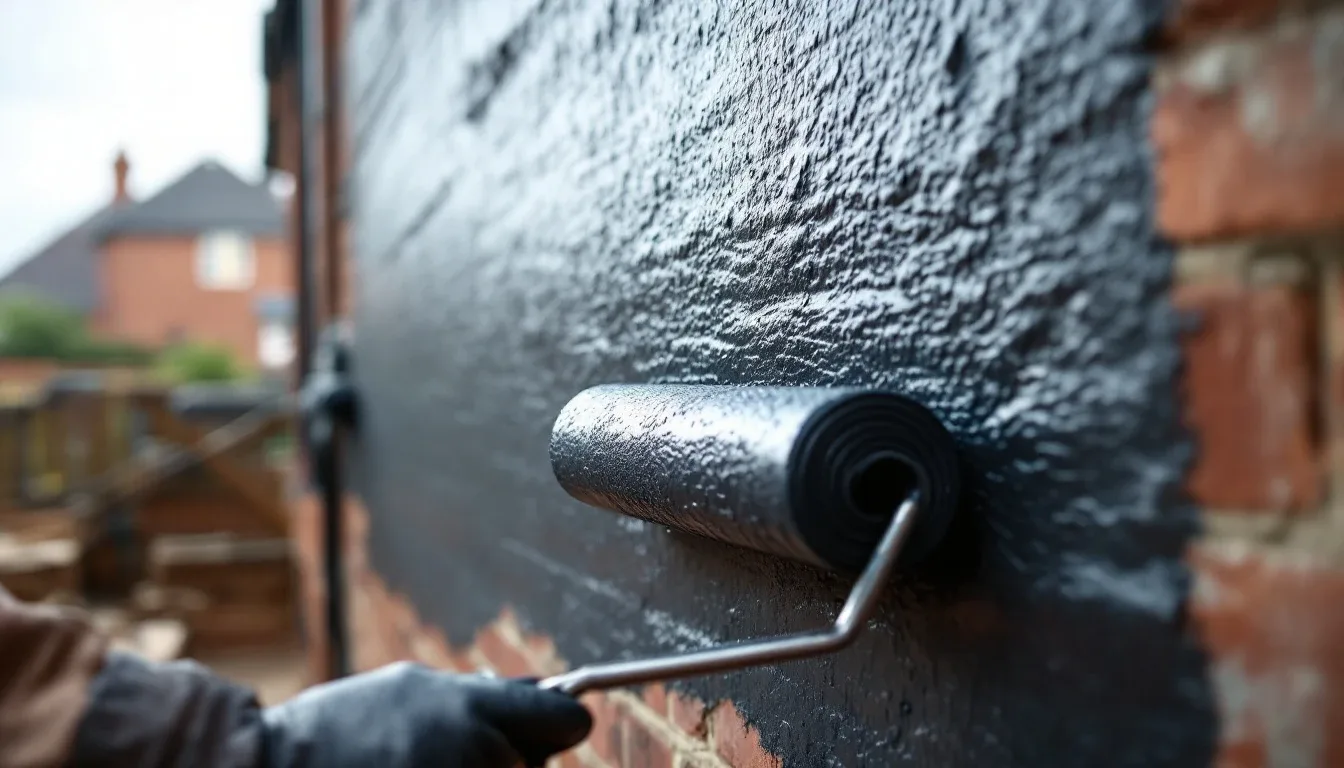
Barrier membranes are applied to the external face of basement walls to prevent water from contacting the structure. They are typically bituminous sheets, liquid-applied coatings, or bentonite clay mats applied before backfilling during construction or major excavation.
Barrier membranes provide the best protection for the structure because water is stopped at the outer surface, but they are only practical during new builds or when external access is available.
Key features:
- Applied externally, so no loss of internal space.
- Protects structure from long-term water contact and deterioration.
- Requires external excavation and access.
- Difficult to repair if punctured after backfilling.
Common materials: Bituminous sheet membrane (Bituthene, Servitherm), liquid-applied polyurethane or acrylic coatings, bentonite clay mats.
Cost: £20-40 per m² materials. Installed cost (including excavation, shoring, and backfilling): £100-200 per m².
Breathable membranes (for external cladding)
Breathable membranes (also called breather membranes or vapour-permeable membranes) are used behind external wall cladding (timber boarding, render, stone facing) to block wind-driven rain while allowing water vapour to escape from the wall structure.
These are not waterproofing in the basement sense but are essential for preventing penetrating damp in external walls.
Key features:
- High water resistance (blocks liquid water).
- High vapour permeability (allows water vapour to pass through).
- Used behind ventilated cladding systems.
Common brands: Tyvek, Pro Clima Solitex, Delta Vent N.
Cost: £5-15 per m² materials.
When to use cavity drain membranes
Basement and cellar conversions
Cavity drain membranes are the standard solution for converting existing basements and cellars to habitable use. They work regardless of structural condition (cracks, settlement, poor mortar) and do not require external access.
High groundwater conditions
Sites with high water tables, clay subsoils, or persistent groundwater ingress benefit from cavity drain systems because water is allowed to drain safely rather than being blocked at the structure (which can create hydrostatic pressure and force water through cracks).
Retaining walls
Retaining walls with soil on one side and habitable space on the other (partially buried rooms, split-level houses) can be waterproofed internally with cavity drain membranes to manage water pressure from the retained soil.
Listed buildings and heritage projects
Internal cavity drain systems do not alter the external appearance of the building, making them suitable for listed buildings and conservation areas where external excavation would require planning consent.
When to use barrier membranes
New-build basements
External barrier membranes are the preferred solution for new construction because they can be applied before backfilling, protecting the structure from water contact and reducing long-term maintenance.
Major excavation or underpinning projects
If external access is already being created for structural work (underpinning, foundation repairs), it is cost-effective to apply external waterproofing at the same time.
Aggressive ground conditions
Sites with sulfates, chlorides, or contaminated groundwater benefit from barrier membranes that prevent chemical attack on the concrete or masonry structure.
Installation: cavity drain membranes (internal walls)
1. Prepare the wall surface
Remove all loose render, plaster, paint, and finishes down to bare masonry or concrete. Brush off dust and debris. Repair major voids or holes with mortar (small cracks and irregularities can be left because the membrane bridges them).
2. Install perimeter drainage channel
A drainage channel (plastic or perforated pipe) is fixed at floor level around the perimeter of the room. This collects water flowing down the back of the wall membrane and directs it to a sump chamber.
The channel must have a minimum gradient of 1:100 sloping toward the sump location.
3. Fix membrane sheets to walls
Cut membrane sheets to fit wall height (typically floor to ceiling or above anticipated water level). Fix to the wall using:
- Mechanical fixings: Plastic plugs and washers at 300-500mm spacing. Most reliable method, especially on uneven surfaces.
- Adhesive: Solvent-free contact adhesive or double-sided tape. Faster than mechanical fixings but less reliable on damp or uneven walls.
Lap vertical joints by 100mm minimum. Use jointing tape or strips to seal laps. Membrane dimples should face the wall, creating the drainage cavity behind.
4. Connect wall and floor membranes
Floor membrane (if used) laps with wall membrane at the perimeter to create a continuous cavity. Water drains from walls, across floor, and into the perimeter channel.
5. Install sump and pump
A sump chamber is installed below floor level (typically in a corner or low point). Water from the drainage channels flows into the sump. A submersible pump lifts water to external drainage.
BS 8102 requires dual pumps and a high-water alarm for habitable basements.
6. Apply vapour control layer
A vapour-control layer (typically 500-gauge polythene sheet) is fixed over the membrane to prevent warm, humid indoor air from condensing on the cold structure behind the membrane. This prevents interstitial condensation that could lead to mould growth in the cavity.
7. Build stud wall and finish
Timber or metal stud walls are built in front of the membrane (50-75mm from the membrane surface). Insulation is added between studs, then plasterboard and skim. This creates a habitable wall surface 100-120mm in from the original structure.
Installation: barrier membranes (external walls)
1. Excavate around the basement perimeter
Dig down to the base of the foundation or basement floor level. Shore the excavation if necessary. Clean the external wall surface of soil, loose mortar, and debris.
2. Repair wall defects
Fill cracks and voids with mortar. Smooth rough surfaces (renders, pointing irregularities) to prevent membrane puncture. Some systems require a protective render coat before membrane application.
3. Apply primer (if required)
Bituminous membranes often require a bitumen primer to improve adhesion. Liquid membranes may require a sealing primer on porous substrates.
4. Apply membrane
Sheet membranes: Torch-on bituminous sheets are heated and pressed onto the wall surface, lapping joints by 100mm. Start at the lowest point and work upward so that water sheds down the laps.
Liquid membranes: Spray or roller-apply in two or three coats, building up to the required thickness (typically 2-3mm total). Reinforce corners and penetrations with mesh tape.
5. Install protection board
A rigid protection board (expanded polystyrene, drainage board, or geotextile) is fixed over the membrane to prevent damage during backfilling. Some systems use dimpled drainage boards that also channel water down to foundation drains.
6. Backfill and compact
Backfill the excavation carefully to avoid damaging the membrane. Use clean fill (no sharp stones or rubble). Compact in layers to prevent settlement.
Common mistakes and how to avoid them
Poor lapping of joints
Insufficient lap (under 100mm) or failure to seal laps creates water paths. Always lap by at least 100mm and use jointing tape or adhesive to seal laps. This is critical at wall-floor junctions and vertical seams.
Blocked drainage channels
Debris (mortar, plaster, insulation) can block perimeter drainage channels, causing water to back up and flood the sump. Protect channels with covers during construction and flush them before final commissioning.
Inadequate sump pump capacity
Undersized pumps cannot keep up with water inflow during heavy rain or high groundwater periods. Calculate sump capacity based on wall area and expected water inflow rate. BS 8102 recommends minimum 0.5 litres per second per 100m² of wall area.1
No vapour control layer
Omitting the vapour barrier over cavity drain membranes allows warm indoor air to condense behind the membrane, creating damp conditions and mould growth. Always install a vapour control layer (500-gauge polythene or equivalent).
Puncturing external membranes during backfilling
Sharp stones or aggressive compaction can puncture external barrier membranes. Always use a protection board over the membrane and backfill with clean, fine-graded material.
Costs and materials
Cavity drain membranes (internal)
- Membrane sheets: £10-20 per m².
- Drainage channels: £15-30 per linear metre.
- Sump chamber: £80-150.
- Pump (single): £150-300. Dual pump system: £400-700.
- Vapour barrier: £2-5 per m².
- Fixings and accessories: £5-10 per m².
Total materials for a 20m² wall: £600-1,200.3
Installed cost (including labour, stud walls, screed, and finishes): £80-150 per m². Full basement (60m² walls and floor): £5,000-9,000.
Barrier membranes (external)
- Bituminous sheet membrane: £15-30 per m².
- Liquid-applied membrane: £20-40 per m² (materials + application).
- Protection board: £10-20 per m².
- Excavation and backfilling: £50-100 per m² (varies by access and depth).
Total installed cost: £100-200 per m². Small basement (40m² external walls): £4,000-8,000.
Maintenance requirements
Cavity drain systems
Annual sump pump testing and cleaning. Check that pumps activate correctly, backup pump functions, and high-water alarm operates. Clear any debris from drainage channels. Most contractors offer maintenance contracts for £150-300 per year.4
Barrier membranes
No routine maintenance required. However, external membranes can be damaged by root growth, ground movement, or excavation work near the building. Any damage is difficult to detect and repair without excavation.
Building Control and BS 8102 compliance
All below-ground waterproofing systems for habitable basements must comply with BS 8102:2009.2 Building Control will require:
- Waterproofing design by a qualified specialist.
- Drawings showing membrane type, drainage paths, sump location, and pump specifications.
- Product specifications and British Board of Agrément (BBA) certificates.
- Installation by an approved contractor.
- Completion certificate confirming compliance with BS 8102.
DIY installations rarely meet these requirements and will fail Building Control inspection.
Sources
- BS 8102:2009: Code of practice for protection of below ground structures against water from the ground (accessed 3 July 2026)
- Building Regulations Approved Document C (2022): Resistance to moisture (accessed 3 July 2026)
- BRE Report BR 528: Basement construction and waterproofing (2012) (accessed 3 July 2026)
- Property Care Association: Code of Practice for Below-ground Waterproofing (2023) (accessed 3 July 2026)